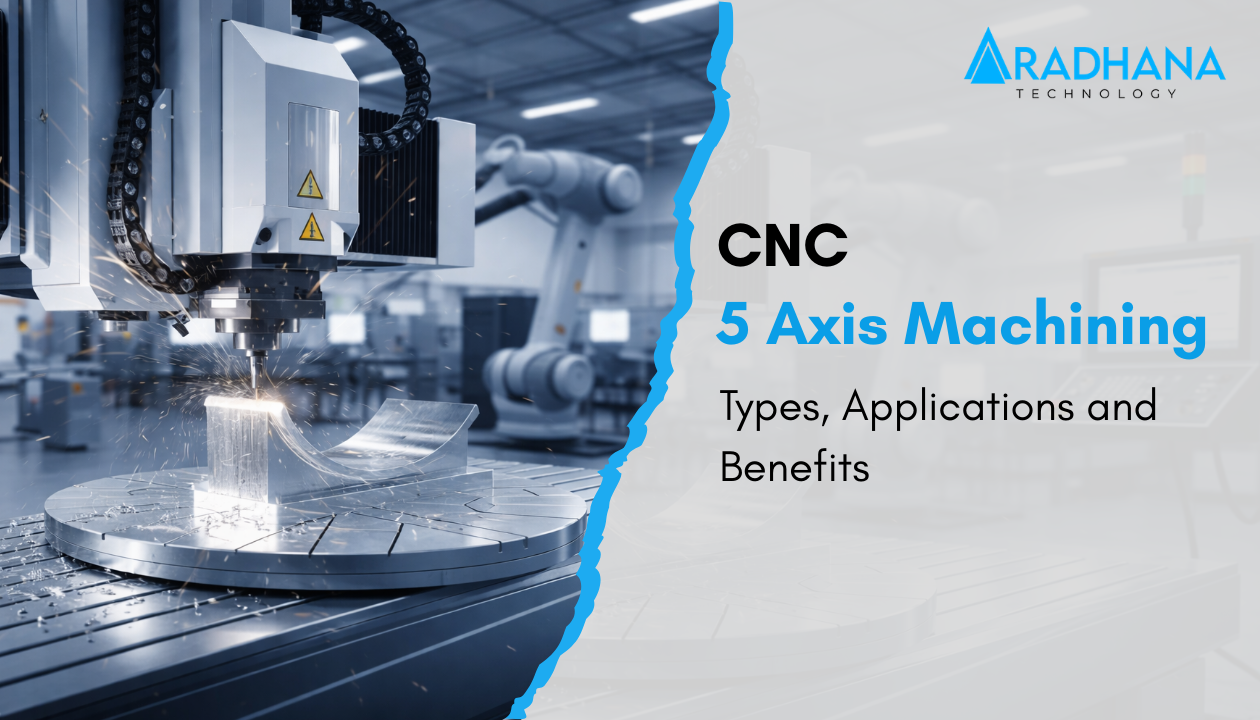
Modern manufacturing demands high precision, faster production, and the ability to create complex geometries. CNC 5 axis machining has become one of the most advanced solutions for industries that require accuracy and efficiency.
From aerospace parts to medical components, this technology delivers superior quality compared to traditional machining methods.
In this blog, we will look into how 5 axis CNC machining works, the different kinds available, the ways it is used, and the advantages it offers, so you can see why it’s important for today’s manufacturing processes.
What is CNC 5 Axis Machining?
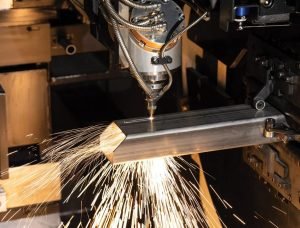
CNC 5-axis machining is a sophisticated manufacturing method where a cutting tool moves along five different directions at the same time to create the desired shape on a workpiece.
Unlike a regular CNC machine that moves along three straight axes (X, Y, and Z), a CNC 5-axis machine also has two more movements that rotate the tool or workpiece.
These extra movements allow manufacturers to machine complex surfaces, deep cavities, and intricate designs in a single setup. Because of this, 5 axis cnc technology reduces production time and improves overall accuracy.
How the 5 Axis CNC Machine Works
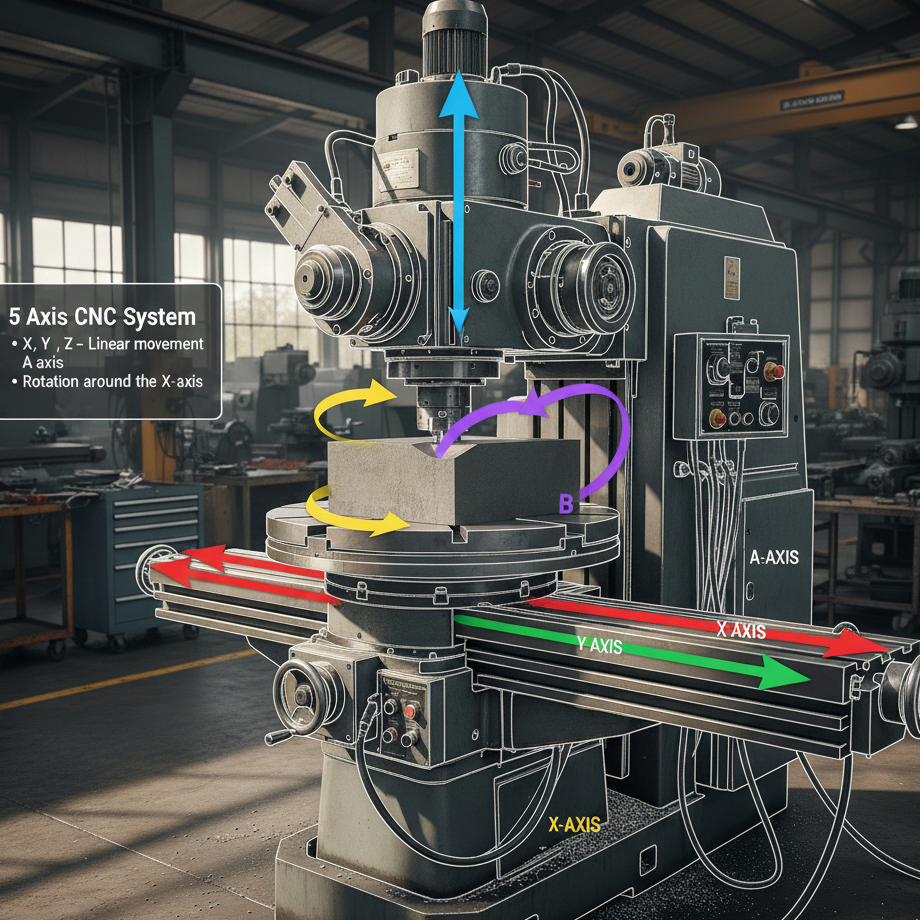
A 5 axes cnc system works using:
- X, Y, Z axes – Linear movement in three directions
- A axis – Rotation around the X-axis
- B axis – Rotation around the Y-axis
This combination allows 5 axis machining to reach difficult angles without repositioning the material. As a result, manufacturers achieve better surface finish and tighter tolerances.
Types of 5 Axis CNC Machines
1. Trunnion-Type 5 Axis Machine
In this setup, the table moves up and down and turns, but the cutting tool stays in place. This kind of 5th axis machine is great for working on big parts and pieces that need to be made with very precise measurements.
2. Swivel Head / Rotary Table Machine
Here, the cutting head moves while the table rotates. Many industries prefer this cnc 5th axis setup for machining complex contours and molds.
3. Continuous 5 Axis Machining Centers
These high tech machines can cut material in five different directions at the same time, which makes them ideal for making parts used in airplanes and jet engines.
4. 5 Axis VMC Machine
A 5 axis vmc machine or vmc 5 axis machine combines vertical machining center functionality with two additional rotary axes, offering flexibility and cost effective production for medium scale industries.
CNC Milling Structure and Diagram
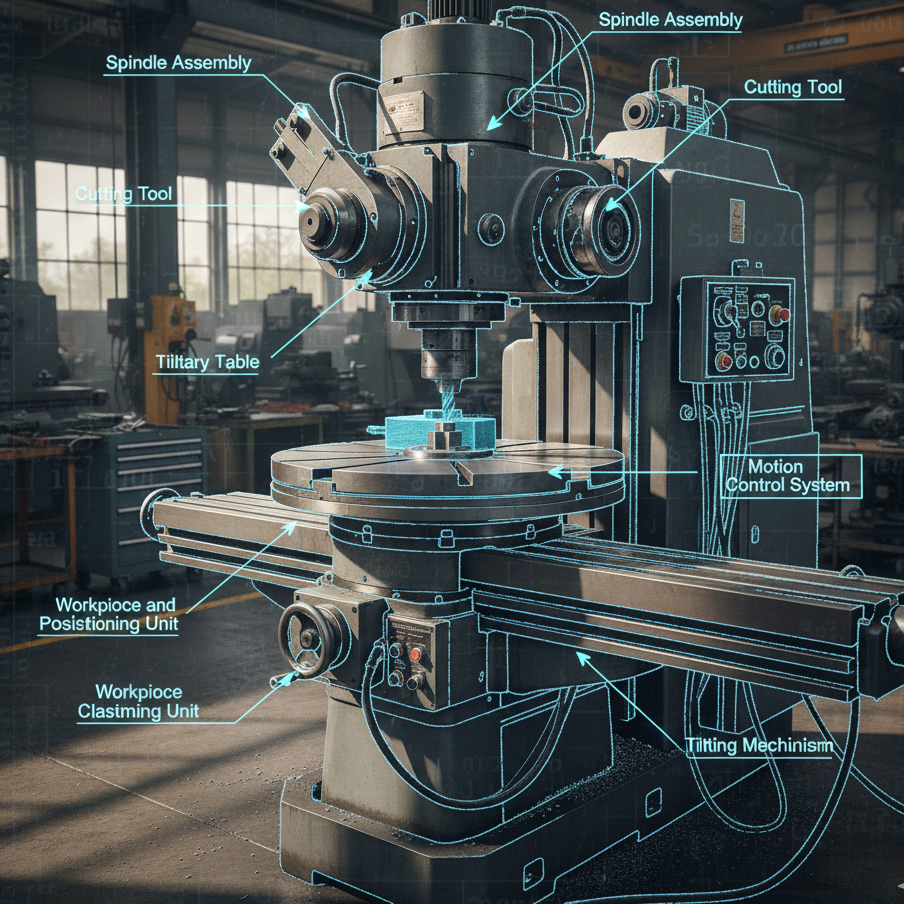
For a deeper insight into machine functionality, engineers study a CNC milling machine diagram. Such diagrams provide a visual breakdown of the machine’s internal framework, including its drive systems, motion mechanisms, and component layout, enabling better analysis of machining performance.
A typical diagram highlights:
- The spindle assembly and cutting tool setup
- The rotary table and tilting mechanisms
- The axis drive and motion control system
- The workpiece clamping and positioning unit
By studying these diagrams, manufacturers gain insight into tool paths, synchronized axis movements, and the overall material removal process in 5-axis CNC systems.
This deeper understanding improves machining precision, enhances programming efficiency, and increases overall production output.
Key Applications of CNC 5 Axis Machining
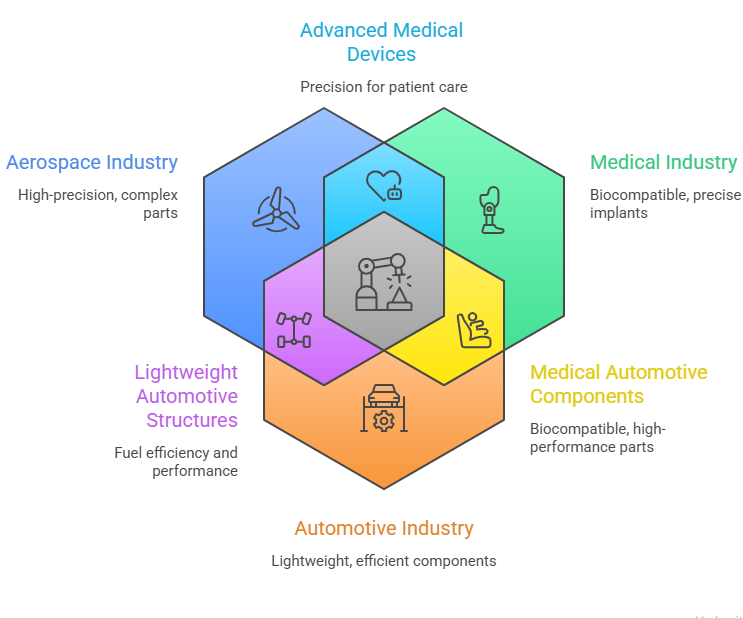
Because of its precision and flexibility, cnc applications of 5-axis technology span across multiple industries:
Aerospace Industry
The aerospace sector heavily depends on CNC 5 axis machining for manufacturing turbine blades, impellers, structural brackets, and engine components.
The ability to machine complex curves and deep cavities in a single setup ensures high precision, reduced weight, and strict tolerance control, which are critical for aircraft safety and performance.
Medical Industry
In the medical field, 5 axis CNC machine technology is used to produce orthopedic implants, surgical instruments, dental components, and prosthetics.
The process provides a very smooth surface and extremely precise measurements at the microscopic level, which helps ensure the material is safe for the body, works reliably, and can be made to fit each patient’s unique needs.
Automotive Industry
Automotive manufacturers use 5 axis machining for engine blocks, transmission components, molds, and rapid prototypes.
The technology improves production speed, consistency, and dimensional accuracy. It enables complex geometries and lightweight designs that enhance vehicle performance, fuel efficiency, and durability.
Tool & Die Manufacturing
CNC 5 axis machining is commonly used in making tools and dies to create complex molds, dies, and casting tools.
The ability to machine several surfaces in a single setup cuts down on the need to move parts around manually, leads to better surface results, and speeds up the overall production process, which makes it very efficient.
Electronics & Precision Engineering
Industries that make electronic devices and precise machinery use 5 axis CNC machines to produce small, complicated parts that need to be made very accurately.
From housings to tiny parts, the process makes sure each piece is finished well, made with the same care every time, and produced in large amounts without losing quality.
Major Benefits of CNC 5 Axis Machining
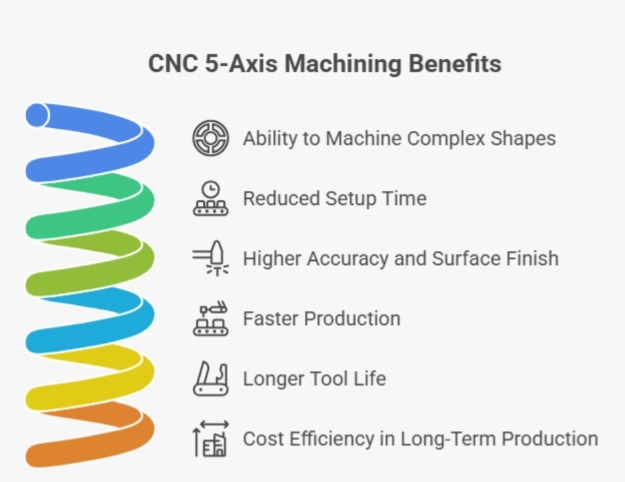
1. Ability to Machine Complex Shapes
Using movement along five axes at the same time, manufacturers can make shapes that traditional machines cannot create.
2. Reduced Setup Time
A cnc 5 axis machine machines multiple sides in one clamping, reducing manual repositioning and improving productivity.
3. Higher Accuracy and Surface Finish
Continuous tool movement ensures better finishing quality, which is critical in aerospace and medical parts.
4. Faster Production
Because fewer setups are needed, 5 axis machining significantly shortens manufacturing cycles.
5. Longer Tool Life
Optimized cutting angles in cnc 5 axes systems reduce tool wear and improve efficiency.
6. Cost Efficiency in Long-Term Production
Although the initial investment in a 5th axis machine is higher, reduced labor, setup time, and errors make it economical over time.
Why Choose 5 Axis CNC Machining for Your Business?
Companies adopting cnc 5 axis machining gain:
- Competitive manufacturing speed
- Superior precision
- Capability to handle complex projects
- Reduced production errors
For industries moving toward automation and high-precision engineering, 5 axis cnc technology is no longer optional, it is essential.
Conclusion
CNC 5 axis machining is shaping the future of high precision manufacturing. With intelligent motion control, minimal setup requirements, and the capability to produce highly complex geometries, it has become essential in aerospace, medical, automotive, and tool manufacturing industries.
Whether you’re thinking about buying a 5-axis CNC machine, upgrading to a VMC 5-axis machine, or learning about the design of advanced CNC milling machines, using 5-axis machining helps you work faster, get smoother results, and keep your machine running efficiently for a longer time.
For businesses seeking reliable and advanced machining solutions,Aaradhana Tech is a trusted name in precision engineering. Aaradhana Tech specializes in high-quality CNC manufacturing services, delivering accuracy, durability, and customized solutions tailored to modern industrial requirements.
With a strong focus on innovation and performance, the company supports clients with dependable CNC 5 axis machining services designed to meet global quality standards and complex project demands.
FAQ’S
1. What is CNC 5 axis machining?
CNC 5 axis machining is an advanced manufacturing process where a cutting tool moves along five different axes simultaneously. This allows complex parts to be machined in a single setup with higher precision, better surface finish, and reduced production time.
2. How is a 5 axis CNC machine different from a 3 axis machine?
A 3 axis machine moves along X, Y, and Z directions only. A 5 axis CNC machine adds two rotational axes, allowing the tool to approach the workpiece from multiple angles without repositioning, improving accuracy and efficiency.
3. What industries use 5 axis CNC machining?
Industries such as aerospace, medical, automotive, tool & die, and precision engineering widely use 5 axis CNC machining for manufacturing complex and high-precision components.
4. What are the main benefits of 5 axis machining?
The major benefits include reduced setup time, improved surface finish, higher accuracy, faster production cycles, longer tool life, and the ability to machine complex geometries.
5. What is a 5 axis VMC machine?
A 5 axis VMC machine is a vertical machining center equipped with two additional rotary axes. It combines vertical milling functionality with advanced multi-axis movement for complex part production.
6. What is 5th axis machining?
5th axis machining refers to the additional rotational movement in a CNC system that enables the cutting tool or workpiece to rotate, allowing complex angles and contours to be machined precisely.
7. Why is CNC 5 axis machining important for aerospace components?
Aerospace parts require tight tolerances and complex shapes. CNC 5 axis machining ensures lightweight design, high precision, and superior surface finish, which are critical for aircraft performance and safety.
8. Does 5 axis CNC machining reduce production cost?
Although the initial machine cost is higher, 5 axis machining reduces manual setup, errors, and production time, making it cost-effective in long-term manufacturing.
9. What is shown in a CNC milling machine diagram?
A CNC milling machine diagram typically illustrates the spindle, rotary table, axis movement system, and workpiece positioning to explain how the machine operates internally.
10. Is 5 axis CNC machining suitable for small components?
Yes, 5 axis CNC machining is highly suitable for small and intricate components, especially in medical and electronics industries where high precision and detailed finishing are required.