
CNC machine working uses computer-controlled programming to perform precise cutting, drilling, milling, carving, and shaping operations. The process generally involves CAD design, CAM programming, machine setup, G-code execution, monitoring, and quality control.
A CNC machine is controlled by a computer and is used to manufacture parts and components by accurately cutting, drilling, carving, and shaping different materials such as metal, wood, plastic, and composites. The CNC machine working process is based on a set of programmed instructions that controls the movement and operations of the machine with high precision.
CNC programming plays an important role in this process, as the required instructions are created and converted into machine-readable commands. CNC machine programming allows the machine to perform accurate and repeatable operations according to the design and manufacturing requirements.
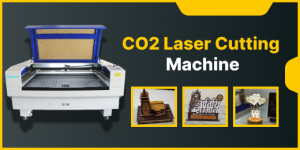
CNC machining includes different types of equipment such as Laser Cutting Machines, CNC Drilling Machines, CNC Plasma Cutters, and many more, making CNC technology useful for a wide range of manufacturing and production applications.
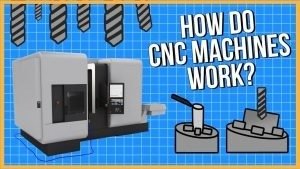
Overview of CNC Machine Working
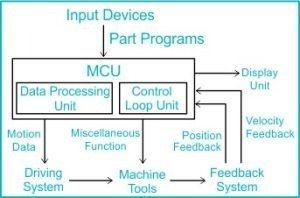
Step 1: Designing the Part:
The first process is to design components by the use of software called CAD (Computer-Aided Design). CAD software permits engineers or designers the create a 3D model of the part and also, includes its dimensions and features.
Design a single part for Computer Numerical Control machining includes different steps to ensure that the final product meets the requirement of specifications and can also be manufactured efficiently.
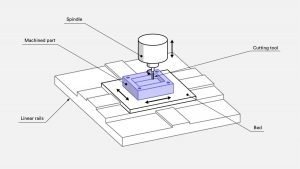
Step 2: Creating CNC Program:
As the first step of designing is completed, the CAD model converts into a program of CNC by the use of software called CAM (Computer-Aided Manufacturing).
CAM program includes instructions that tell the right movements and the operations that are required for manufacturing the part. In the Creation of a CNC, the program includes converting a part of the design into a single set of instructions (G-code) which could CNC machine will follow to manufacture parts.
Step 3: Setting Up the Machine:
The operator of the Computer Numerical Control machine loads the CNC program into the control unit of the machine.
They also mount the workpiece carefully onto the machine’s worktable or fixture. Setting up a machine involves machine preparation, workpiece setup, tool setup, CNC program loading, cutting parameters adjustment, tool and workpiece measurement & test run, and final checks.
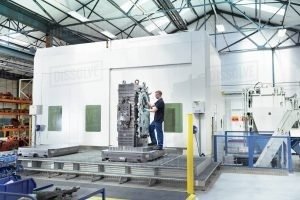
Step 4: Execution of Program:
Next is the execution of the program of the CNC machine working, which includes a set of series of movements with the X, Y, and Z axes.
To execute the machine the first is to initialize the machine, and verify the workpiece and tool, pre and postexecution checks are important.
Step 5: Monitoring and Quality Control:
In the process of machining, the operator monitors the operation of the machine and also ensures that all of the things are proceeding according to the planned manner.
Another thing is they also perform quality checks on the workpiece to confirm it meets the required tolerances and specifications. The process of monitoring and quality control are important things in CNC machining to confirm the accuracy, consistency, and reliability of machined parts.
Step 6: Completion of CNC Machine Working:
After the completion of the machining process, the last step is to remove from the machine. It depends on the complexity of the part and also the particular requirements of the application, additionally finishing operations like deburring, polishing, or surface treatment could be necessary.
In the last step quality assurance is important to verify the accuracy of dimensions, also packaging and shipping.
G-Code vs M-Code in CNC Machining
CNC (Computer Numerical Control) machines operate using specific programming languages, primarily G-Code and M-Code. Both are essential parts of a CNC machine program, but they serve different purposes in the operation and control of the machine.
G-Code, also known as Geometric Code, is responsible for defining the movement and positioning of the machine’s tool. It forms an important part of a CNC program and instructs the machine on how to move, whether in a straight line or along a curve, and at what speed and feed rate. Commands like G00 (rapid positioning) and G01 (linear interpolation) determine the motion, while G90 (absolute positioning) and G91 (incremental positioning) help in setting the coordinate system. G-Code essentially dictates how the cutting tool interacts with the material, ensuring precision and efficiency.
G-Code is also commonly used in VMC programming, where programmed movements control the cutting tool during different machining operations. In practical applications, CNC machine programs contain different G-Code commands according to the required machining process.
On the other hand, M-Code, or Miscellaneous Code, controls the non-motion functions of the machine. It handles essential operations like turning the spindle on or off, managing coolant flow, and stopping or ending the program. Commands such as M03 (spindle on in a clockwise direction), M05 (spindle stop), M08 (coolant on), and M09 (coolant off) ensure the smooth operation of the machine’s auxiliary systems.
Unlike G-Code, which focuses mainly on movement, M-Code deals with the supporting functions that enable the machine to operate efficiently. Together, G-Code and M-Code form an important part of a CNC machine program and VMC machine programming.
Understanding these commands is essential for anyone working with CNC VMC programming, CNC machining, or computer numerical control systems. A CNC code list containing commonly used G-Codes and M-Codes can help operators and programmers understand the instructions used to control different machine functions.
Conclusion
In summary, CNC machines offer high precision, repeatability, and efficiency in the manufacturing of a wide range of parts and components for different industries, including automotive, aerospace, electronics, and healthcare.
Knowing CNC machine working, CNC programming, and CNC machine programs is important for achieving accurate and consistent production results. During the machining process, continuous improvement, adherence to quality standards, and effective communication with customers are also important for successful production.
If you are looking for reliable CNC machines for manufacturing and production requirements, Aaradhana Technology Systems offers a range of CNC solutions for different applications. Explore our CNC machine range or contact Aaradhana Technology Systems today to discuss your requirements and find the right CNC solution for your business.
FAQ’s
A CNC (Computer Numerical Control) machine is an automated manufacturing machine controlled by computer programming. It follows programmed instructions to perform operations such as cutting, drilling, milling, carving, and shaping materials with high precision.
The main steps include designing the part using CAD software, creating the CNC program using CAM software, setting up the machine, executing the program, monitoring the machining process, and performing quality checks after production.
CNC programming is the process of creating instructions that tell a CNC machine how to move, operate its tools, and perform specific machining operations. These instructions are commonly written using G-code and M-code.
A CAD model is converted into a CNC program using CAM (Computer-Aided Manufacturing) software. The CAM software generates machine instructions, commonly including G-code, which the CNC machine follows to manufacture the designed part.
G-code is a programming language used to control the movement and positioning of CNC machine tools. It contains instructions for movements, positioning, speed, feed rate, and toolpaths during machining.
M-code, or Miscellaneous Code, controls non-motion functions of a CNC machine. It can be used for operations such as spindle control, coolant activation, and stopping or ending a program.
G-code primarily controls the movement and positioning of the machine tool, while M-code controls auxiliary machine functions such as spindle operation, coolant, and program stops. Both are important parts of CNC machine programming.
Depending on the machine type and tooling, CNC machines can work with materials such as metal, wood, plastic, and composites. The appropriate machine and cutting tools should be selected according to the material and application.
Monitoring helps ensure that the machining operation is proceeding according to the programmed instructions. Operators can also perform quality checks to confirm that the finished workpiece meets the required dimensions, tolerances, and specifications.
CNC machine working provides high precision, repeatability, efficiency, and consistent production. It also reduces manual intervention and allows manufacturers to produce complex components accurately across different applications and industries.